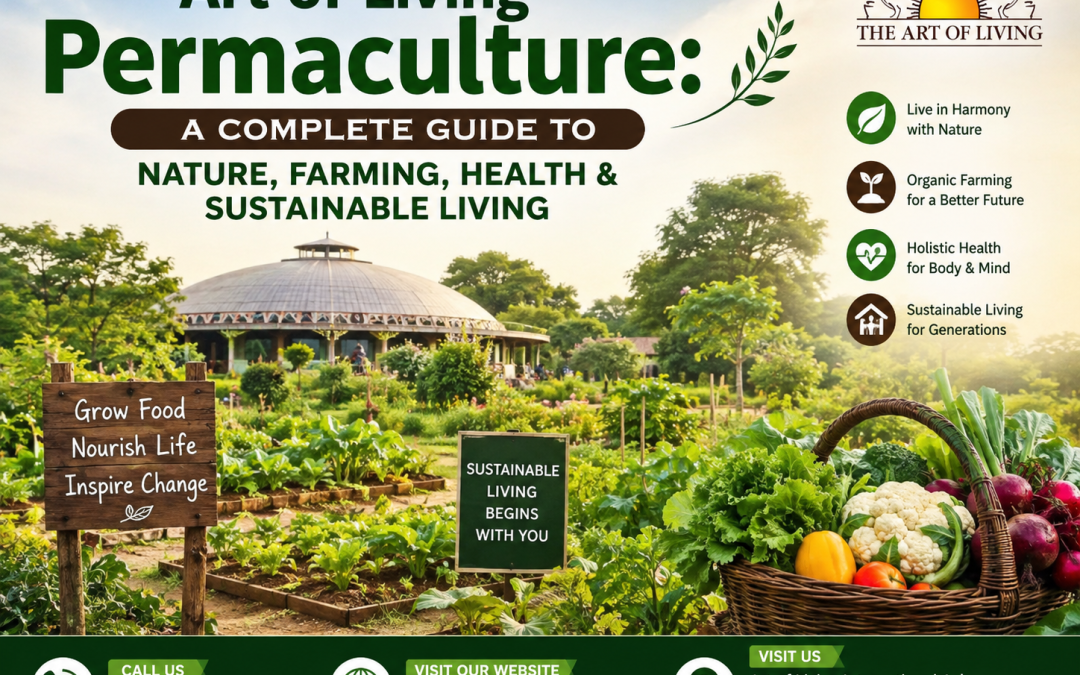
In today’s world, health concerns are increasing while the younger generation is becoming increasingly disconnected from farming, food production, and nature. This creates a need for a sustainable and practical approach to living.
This podcast series takes a deep dive into Permaculture—what it means, how it connects farming with everyday life, how it can support healthier communities, and why it may play an important role in the future of Indian agriculture.
Through conversations with Binay Bhaiya, Head of Art of Living Permaculture, the series explores everything from the fundamentals of permaculture to farming, water conservation, land buying, cow-based farming, sustainable living, and the future of agriculture.
Phase 1: Understanding the Basics
1. What Is Permaculture? A Complete Beginner’s Guide
What exactly is permaculture?
Binay Bhaiya explains permaculture through a simple example: a house has a bedroom, bathroom, prayer room, parking area, and several other spaces. All these components together make a complete home.
In the same way, permaculture is much more than farming. It looks at the complete system of life and asks how our lifestyle can become more sustainable.
Permaculture encourages us to think beyond the food we grow. Our clothing, water usage, waste, energy consumption, surroundings, and everyday choices are all connected to our health and the environment.
The basic idea is simple: our life itself should become sustainable.
2. Permaculture Design 101: Core Principles Every Beginner Should Learn
Permaculture works as an interconnected system.
Binay Bhaiya compares it to a car. A car cannot run simply because its four tyres have air. The engine, brakes, ignition, tyres, steering, and other components all need to function properly.
Similarly, a sustainable ecosystem depends on many interconnected elements.
Permaculture teaches us that every component has value. Even something as small as a pin can be as important to the overall system as a large tyre.
When all these components work together, the system becomes stronger, healthier, and more resilient.
3. Permaculture vs. Regenerative Agriculture: Understanding the Key Differences
There are several terms used today, including organic farming, natural farming, regenerative agriculture, and permaculture.
Natural farming focuses on reducing or eliminating chemical inputs and working more closely with natural processes.
Permaculture takes a broader approach. It does not look at agriculture as an isolated activity. Instead, it considers farming, water, animals, energy, waste, human lifestyle, community, and the environment as interconnected parts of one system.
As Binay Bhaiya describes it, “Permaculture is the big brother.”
The goal is not simply to grow food without chemicals but to create a lifestyle and ecosystem that can remain sustainable over the long term.
4. Climate-Smart Agriculture: How Permaculture Offers Real Solutions for India
Modern agriculture has become increasingly dependent on external inputs, industries, energy, water, and chemical-based fertilizers.
This dependence can create serious challenges during geopolitical or economic disruptions.
Permaculture aims to reduce such dependencies by improving soil health, conserving water, increasing biodiversity, integrating animals and plants, and making farms more self-reliant.
The long-term goal is to move towards agriculture that is nature-based, resilient, and less dependent on external resources.
Phase 2: Getting Started
5. Regenerative Farming in India: A Beginner’s Guide to Getting Started
Starting a farming journey requires patience.
People often spend 15–20 years studying, developing professional skills, or building a business. Farming also requires time to understand the land, develop systems, build a customer base, and establish a sustainable income.
Binay Bhaiya emphasizes that young people should not expect farming to become successful overnight.
Food is different from most products because everyone needs it. The opportunity exists, but farmers need to understand that producing food and selling food are two different skills.
A successful farm therefore requires both good production and effective marketing.
6. How to Start a Farm in India: A Step-by-Step Guide for New Farmers
Starting a farm should begin with proper planning.
A new farmer needs to consider:
- Where to buy or access land
- How to manage water
- What crops to grow
- How to improve soil health
- How to integrate trees and animals
- Who the customers will be
- How the produce will be sold
- How the farm will generate sustainable income
One of the most important lessons is to build the customer base along with the farm.
Instead of producing large quantities first and searching for buyers later, farmers can develop direct relationships with consumers.
For young people considering agriculture as a career, farming can become a meaningful business when production, planning, and marketing work together.
7. Agricultural Land Buying Tips in India: What Every First-Time Buyer Should Know
Buying agricultural land is one of the most important decisions for a new farmer.
Having money does not automatically make the process simple. Land ownership, revenue records, documentation, registration, electricity access, fencing, water availability, and other legal considerations need to be carefully evaluated.
A mistake at the land-buying stage can create significant financial and legal problems later.
Therefore, anyone planning to buy agricultural land should take appropriate professional and legal guidance and verify all relevant documents before making a purchase.
Phase 3: Practical Farm Systems
8. Rainwater Harvesting for Farms: Techniques Every Indian Farmer Should Adopt
Water is one of the most important resources in agriculture, yet groundwater levels are declining in many regions.
Permaculture focuses strongly on rainwater harvesting and groundwater recharge.
Binay Bhaiya explains the basic concept in three simple words:
Slow it. Spread it. Sink it.
Instead of allowing rainwater to quickly run away, the goal is to slow its movement, spread it across the land, and allow it to gradually enter the soil.
Farm ponds, contour systems, recharge structures, tanks, and rooftop rainwater harvesting can all help conserve water depending on the location and landscape.
Even urban households can participate by collecting and storing rainwater instead of allowing it to flow away unused.
9. Cow-Based Natural Farming: Principles, Benefits, and How to Begin
Animals play an important role in a natural farming ecosystem.
Cows can contribute manure, organic matter, nutrients, and biological activity to the farm. Their presence can help create a more integrated farming system when managed responsibly.
The podcast also discusses the relationship between animal manure, soil health, and water conservation.
Rather than treating livestock and agriculture as separate activities, permaculture encourages farmers to integrate them into the same ecosystem.
A farm with plants, soil, water, trees, and animals can become more self-sustaining than a system that depends entirely on external inputs.
10. Forest Gardens Explained: Building a Self-Sustaining Permaculture Ecosystem
A healthy ecosystem is not based on a single crop or a single resource.
Forest gardens and diversified farming systems attempt to imitate natural ecosystems by combining different layers of plants, trees, crops, and supporting organisms.
This approach can improve biodiversity and reduce dependence on external inputs.
The larger principle discussed in the podcast is that economy and ecology should work together.
Economic development that continuously damages natural resources cannot remain sustainable indefinitely. A stronger model is one where economic activity is supported by healthy soil, clean water, biodiversity, and functioning ecosystems.
11. How to Start and Sustain a Gaushala Within a Farming System
The podcast explores the traditional relationship between Indian households, cows, and agriculture.
Historically, livestock was closely connected with farming and household life. Today, specialized gaushalas have become more important because many households no longer keep cattle.
A well-managed gaushala can become part of a larger ecological system when connected with agriculture, manure management, soil improvement, and responsible animal care.
The central idea is integration.
Rather than treating cows as a completely separate activity, permaculture looks at how animals, farms, soil, water, and human communities can support one another.
Phase 4: Learning & Inspiration
12. Permaculture in Bangalore: Farms, Ashrams, and Learning Centers to Visit
The Art of Living Ashram in Bengaluru provides an opportunity to observe different aspects of sustainable living and permaculture.
According to the podcast, the ashram is open to visitors during the day, and guests can explore different areas including the permaculture farm, goshala, and gurukul.
Visitors interested specifically in the permaculture farm may need to arrange an appointment in advance.
Experiencing a working farm and observing these systems directly can provide a different kind of learning compared with simply reading about permaculture.
13. Gurudev Sri Sri Ravi Shankar’s Vision for Permaculture and Sustainable Living
The podcast highlights Gurudev Sri Sri Ravi Shankar’s vision of moving agriculture towards a more natural and nature-based approach.
The initiative aims to encourage farming systems that reduce dependence on external inputs, improve sustainability, support farmers, and reconnect people with nature.
Binay Bhaiya explains that the project began with Gurudev’s blessing and guidance, and that the work has continued as a long-term effort.
The broader vision is to create greater awareness about food, farming, health, ecology, and sustainable living.
14. Why the Art of Living Permaculture Movement Is Shaping India’s Farming Future
The future of agriculture depends not only on farmers but also on consumers.
People need to understand where their food comes from, how it is produced, and how their purchasing choices affect farmers, soil, water, and the environment.
Permaculture encourages a deeper connection between people and the food they eat.
The philosophy is not simply about farming. It is about developing greater awareness, responsibility, and connection with nature.
As discussed in the podcast, qualities such as clarity of mind, purity of heart, and sincerity in action can become part of a lifestyle connected to nature and food production.
Phase 5: Community & Events
15. Top Reasons to Attend a Permaculture Conference in India
Starting a farming journey alone can feel difficult.
A strong community can provide knowledge, practical experience, encouragement, and connections with people who are already working in the field.
The podcast highlights the importance of networking because farmers, consumers, entrepreneurs, experts, and young people can learn from one another.
A conference can bring these different groups together in one place.
The idea is simple: when you find fellow travellers on the same path, the journey becomes easier and more enjoyable.
16. National Conference on Permaculture 2026: Everything You Need to Know
The podcast promotes a two-day permaculture conference scheduled for 22–23 August 2026.
The event is presented as an opportunity for farmers, consumers, young people, entrepreneurs, agriculture students, and anyone interested in sustainable living to learn from experienced practitioners and experts.
The discussions are expected to cover several practical areas, including:
- Agricultural land buying
- Legal and documentation considerations
- Rainwater harvesting
- Groundwater recharge
- Natural and regenerative farming
- Cow-based farming systems
- Tree planting
- Farm economics
- Direct marketing
- Consumer awareness
- Sustainable agriculture
- Building resilient farming systems
The event also aims to create a community where people can share experiences, discuss challenges, and find practical solutions.
Gurudev Sri Sri Ravi Shankar is also highlighted as an important part of the event.
The invitation is not limited to farmers. Consumers, professionals, students, entrepreneurs, and families can also participate because everyone is connected to food and agriculture.
Podcast Series at a Glance
Episodes 1–4: Awareness & Fundamentals
Understand the meaning of permaculture, its core principles, its relationship with natural farming, and its potential role in creating climate-resilient agricultural systems.
Episodes 5–7: Starting Your Farming Journey
Learn about the mindset required to enter farming, planning a farm, understanding the market, and important considerations when purchasing agricultural land.
Episodes 8–11: Practical Farm Systems
Explore rainwater harvesting, groundwater conservation, animal integration, cow-based farming, forest gardens, and sustainable farm ecosystems.
Episodes 12–14: Inspiration & Real-Life Learning
Discover the Art of Living Ashram, learn about Gurudev Sri Sri Ravi Shankar’s vision, and understand how permaculture can contribute to India’s agricultural future.
Episodes 15–16: Community & Conference
Understand why community matters in farming and learn about the National Conference on Permaculture 2026, its practical sessions, experts, networking opportunities, and broader vision.
Why This Permaculture Journey Matters
Permaculture is not simply a farming technique. It is a way of looking at the relationship between people, food, soil, water, animals, nature, and society.
The podcast presents an important question for the future: if our food system depends heavily on external inputs and our younger generation becomes increasingly disconnected from farming, who will produce the food we depend on?
The answer begins with awareness.
We do not all need to become farmers. However, we can all understand where our food comes from, support responsible farming, conserve water, reduce unnecessary consumption, protect soil, and make more informed choices.
For those who want to become farmers, permaculture provides a broader framework for thinking about land, water, biodiversity, animals, markets, and long-term sustainability.
For consumers, it provides an opportunity to reconnect with the source of their food.
And for the younger generation, it opens the possibility of seeing agriculture not as an outdated profession, but as an important field with opportunities for entrepreneurship, innovation, community building, and meaningful work.
The journey towards sustainable living begins with small steps—but those steps become powerful when communities take them together.